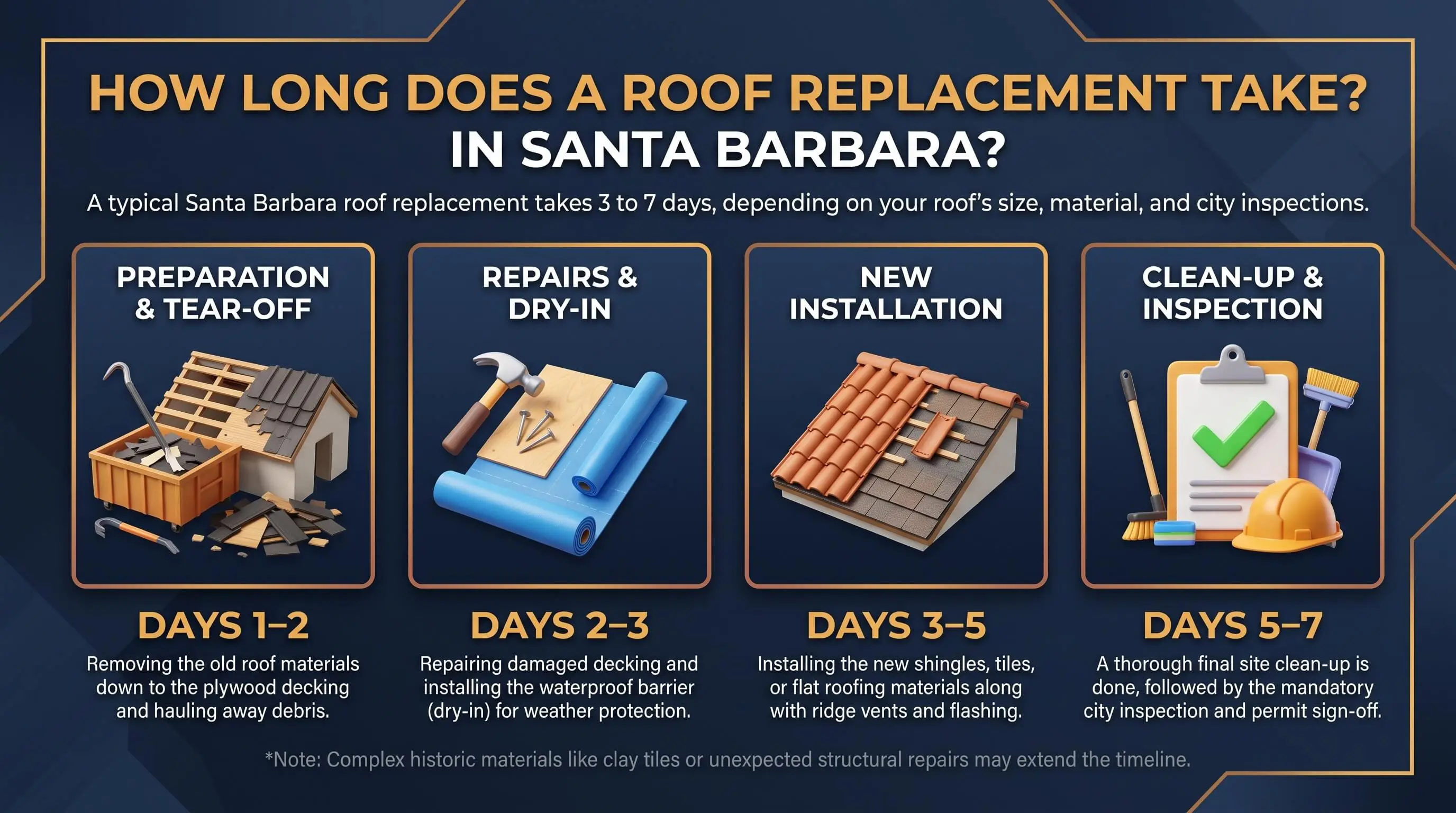
A crew can tear off and reinstall most Santa Barbara roofs in three to five working days . What surprises homeowners is the rest of the calendar, because the full project, from your first call to the final city inspection, tends to run three to six weeks .
Where your home sits and what's on it explain most of that gap. A clay tile roof on a Riviera home in a fire zone moves on a different schedule than asphalt shingles on a Goleta ranch house. If you're planning roof replacement in Santa Barbara, start with those two details. The timelines below take it from there.
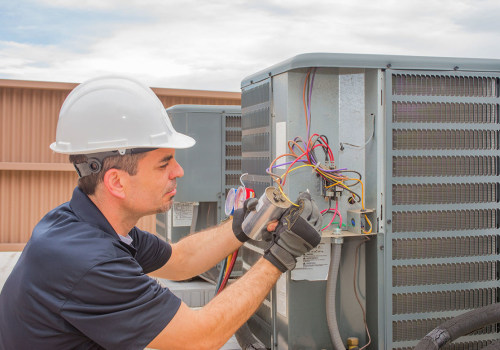
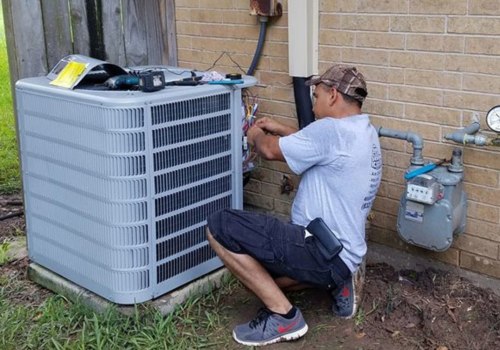
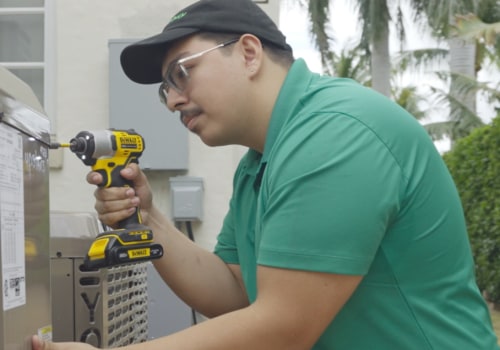
There's an HVAC side to this, too. Your roof covers the attic and the ductwork running through it, and it holds up any condenser or vent stack on top. Ask how your roofer will handle those before you sign anything.
TL;DR Quick Answers
Roof Replacement Santa Barbara
Most Santa Barbara roof replacements take three to five days on the roof and three to six weeks from first call to final inspection . Your material, your fire zone, and the rainy season decide most of that schedule.
Time on the roof: Shingle and flat roofs often take 1 to 3 days. Clay or concrete tile takes 5 to 10, and slate takes 7 to 14 .
Before work starts: Every reroof needs a city building permit. Homes in a High Fire Hazard Area need a Class A or noncombustible roof, and HOA or design review can add weeks.
Best time to book: Late spring through early fall. Santa Barbara gets most of its rain from December through March.
Most common delay: Rotted decking that the crew finds at tear-off. Ask for per-sheet repair pricing in your estimate.
Rooftop equipment: Your crew may need to lift or reset condensers, vents, and solar panels, so schedule an HVAC check afterward.
Who to hire: A licensed local roofer who pulls the permit and puts your schedule in writing.
Top Takeaways
Budget three to five days on the roof and three to six weeks overall .
Ordering material and securing approvals take up most of that time
The material you pick sets the crew's pace.
Shingle and flat roofs often finish in one to three days
Clay tile, concrete tile, and slate can take one to two weeks
Approvals happen before tear-off.
Every reroof needs a city building permit
Fire-zone rules, HOA sign-off, and design review can each add weeks
The 2025 fire map update brought some homes into new zones
Summer and early fall give you the safest window.
December through March brings most of the year's rain
Count on at least one surprise under the old roof.
Rotted decking is the usual culprit, so get per-sheet pricing up front
Two Clocks: Days on the Roof vs. Weeks From First Call
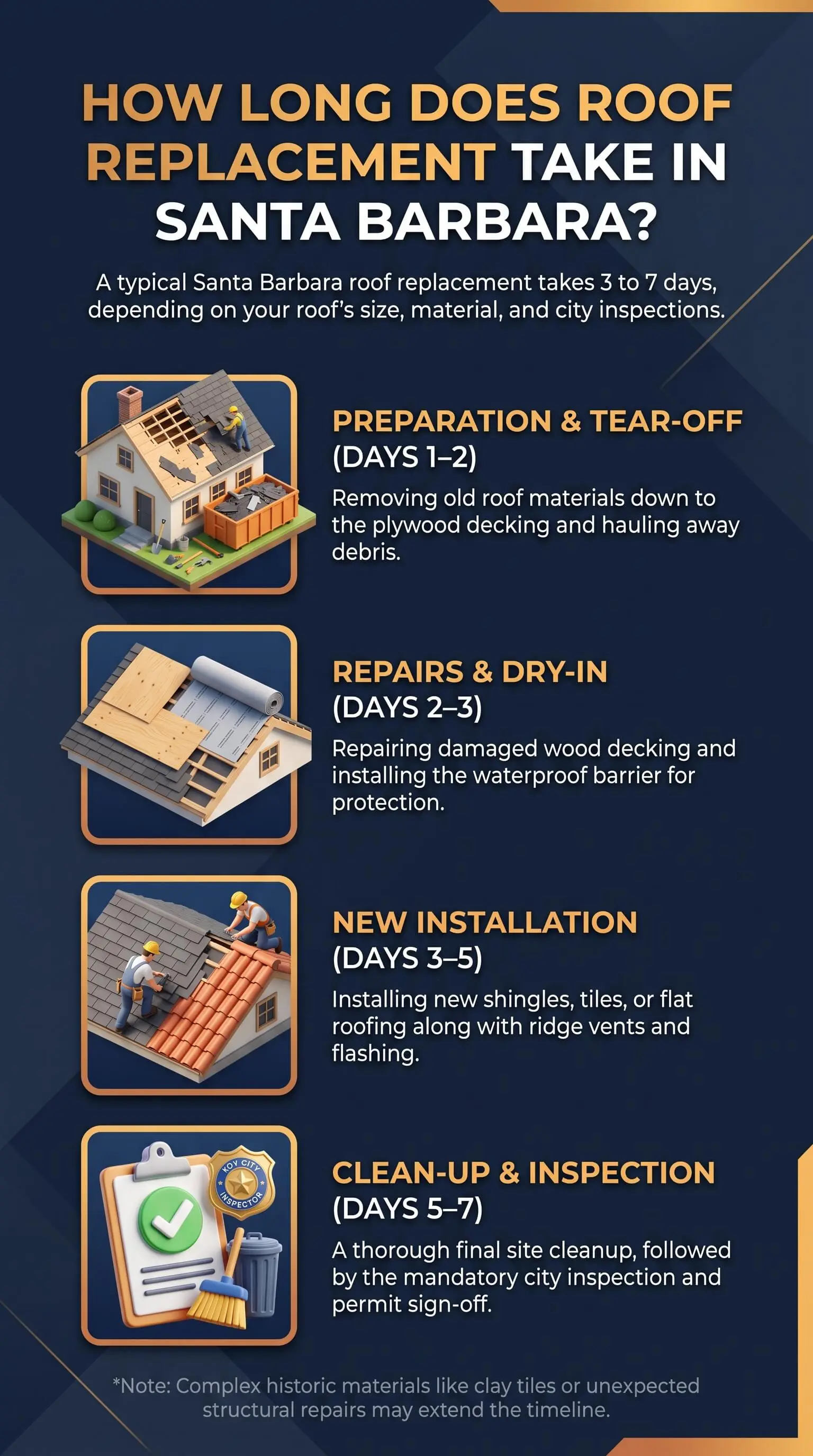
Every Santa Barbara reroof runs on two clocks. The crew clock covers tear-off and installation, which usually takes three to five days . The project clock starts the day you call and stops when the city signs off. Expect three to six weeks on that one , and know that ordering material and lining up approvals use up most of it.
Here's how a typical project breaks down :
Inspection and estimate (a few days to 1 week): Your roofer checks the roofing, decking, and ventilation, then hands you a written quote.
Material selection and ordering (1 to 3 weeks): You choose the material and color, and your roofer orders and stages tile or specialty products.
Permits and approvals (days to several weeks): Your roofer files for the building permit. Fire-zone, HOA, or design review adds time when it applies to your home.
Tear-off (usually day 1): The crew strips the old roof down to the deck.
Deck inspection and repair (a few hours to 1 extra day): The crew pulls damaged sheathing and installs new boards.
Underlayment, flashing, and installation (2 to 4 days for most homes): The crew installs the new system to manufacturer standards.
Final inspection and cleanup (1 to 2 days): You get a contractor walkthrough and a city inspection, and the crew hauls everything away.
Most local projects can start two to four weeks after you sign an estimate . Sign in August, and your new roof can be finished well before the first winter storm.
How Long Does Roof Replacement Take by Material?
Nothing changes the crew's pace like the material you choose. Shingles go down fast. Tile and slate don't, because they're heavy, the crew sets them by hand, and someone has to stage them across the roof before installation begins.
Typical days on site and expected lifespan for an average-size home :
Asphalt shingle: 1 to 3 days on site, lasts 20 to 35 years
Flat roofing (TPO, PVC, torch down): 1 to 3 days on site, lasts 15 to 30 years
Synthetic slate, shake, or tile: 2 to 5 days on site, lasts 40 to 50 years
Concrete tile: 5 to 10 days on site, lasts 40 to 50 years
Clay tile: 5 to 10 days on site, lasts 50+ years
Natural slate: 7 to 14 days on site, lasts 75+ years
A simple single-story roof can come in under those ranges. Add a second story, several valleys, and a tower to a Mediterranean home, and it'll run long.
Santa Barbara Factors That Change Your Timeline
Online averages don't account for what makes Santa Barbara different. Most of the factors below add time before a crew ever climbs a ladder.
Permits and Fire-Zone Requirements
The City of Santa Barbara requires a building permit for every reroof, and the city says it can take one to four business days to process a submittal. Give the fire rules more of your attention. In a High Fire Hazard Area, your new roof has to be Class A or noncombustible, and the city doesn't allow untreated wood shakes. The city's updated fire hazard maps took effect July 31, 2025, and they placed some homes in a zone for the first time. Check your address before you settle on a material.
HOA and Design Review
In Montecito, Hope Ranch, and many private communities, an architectural committee reviews roof color, profile, or material before work starts. Sometimes that review outlasts the installation. Submit your material choice as soon as your quote is in hand.
Historic and Coastal Homes
Older Spanish and Mediterranean homes usually call for tile that matches the original color and profile. Tracking it down, or salvaging the original tile, adds ordering time. Coastal properties may come with extra compliance steps, too.
The Rainy Season
Santa Barbara gets most of its rain between December and March, with January and February the wettest. Rain is rare from May through September. No good crew opens a roof with a storm on the way, so a winter job can sit idle for days between dry spells. Given the choice, book summer or early fall.
What Happens to Your HVAC and Rooftop Equipment During a Reroof?
Your crew has to lift, work around, or reset anything mounted on or through the roof. That means rooftop condensers, package units, vent stacks, skylights, and solar panels. Solar usually needs its own spot on the schedule, since the panels often come off and go back on.
A reroof is also the easiest moment to fix attic ventilation. Poor venting traps heat in the attic and makes your AC work harder all summer long. When the roof is finished, have your HVAC technician check that the vents, line sets, and ductwork came through undisturbed, and fold that visit into your regular HVAC maintenance and inspections.
Hidden Delays and How to Avoid Them
Most delays hide under the old roof, and nobody sees them until tear-off. Here are the ones that come up most, plus how to stay ahead of each.
Rotted decking: Older homes often carry water damage beneath the tile or shingles. Ask for a per-sheet replacement price in your estimate so a repair never becomes a mid-job negotiation.
More than one old layer: Removing two layers takes noticeably longer than removing one. Find out how many your roof has.
Steep or complex rooflines: A steep pitch calls for extra safety setup, and each valley, dormer, and chimney needs custom flashing.
Backordered tile: Specialty tile and some colors take weeks to arrive. Don't let anyone start tear-off until the material sits on your property.
Inspection timing: The city asks for inspection requests in advance. A roofer who pulls your permit should plan around that.
"Homeowners always ask how many days we'll be on the roof, and in Santa Barbara that's the easy part to predict. We set the real schedule before tear-off, once we know whether the tile is in stock, whether the house sits in a fire zone, and whether an HOA needs to sign off. On a clay tile home, I'd rather take an extra week to confirm material and approvals than leave a roof open while we wait on one missing pallet. Call us in late summer, and most homes are dry and done before the first winter storm."
Essential Resources
We'd hand these links to any neighbor who's about to replace a roof in Santa Barbara.
1. Verify Your Roofer's License Before You Sign
CSLB: Check a Contractor License. Type in a license number or business name to see whether the license is active and whether it carries any complaint disclosures. The whole check takes under a minute. https://www.cslb.ca.gov/onlineservices/checklicenseII/checklicense.aspx
2. Know What a Fair Roofing Contract Looks Like
CSLB: Hiring a Contractor. California's own checklist walks you through written contracts and down payment limits. When a contract spells out the scope, it usually spells out the schedule as well. https://www.cslb.ca.gov/Consumers/Hire_A_Contractor/
3. Understand How Santa Barbara Permits Work
City of Santa Barbara: Building Permit Forms and Applications. See how the city handles permit applications and how long reviews tend to take, including what your roofer files on your behalf. https://santabarbaraca.gov/node/2180
4. Check the Fire-Zone Rules for Your Roof
City of Santa Barbara: High Fire Construction Standards. These are the city's rules for building in a High Fire Hazard Area, Class A roofing requirement included. Read them before you get attached to a material. https://santabarbaraca.gov/sites/default/files/documents/Fire/Fire%20Prevention%20Forms/High%20Fire%20Construction%20Standards.pdf
5. See Whether the 2025 Map Update Affects You
City of Santa Barbara: Updated Fire Hazard Maps. New fire hazard zone maps took effect July 31, 2025. If your home sits in a newly mapped area and the city hasn't issued your building permit by that date, the High Fire Hazard Area rules apply to your project. https://santabarbaraca.gov/node/15115
6. Look Up Your Property's Statewide Fire Hazard Zone
CAL FIRE: Fire Hazard Severity Zones. California rates areas as moderate, high, or very high hazard. Look up your address early so a zone change doesn't send you back to square one on materials. https://osfm.fire.ca.gov/fhsz/
7. Plan Around Santa Barbara's Weather
WeatherSpark: Santa Barbara Year-Round Weather. Month-by-month rain and temperature charts that make the case for a summer install better than we can. https://weatherspark.com/y/1443/Average-Weather-in-Santa-Barbara-California-United-States-Year-Round
If you only have time for two, start with the license lookup and your fire zone.
Supporting Statistics
Before you put a date on the calendar, these numbers are worth a look.
Stat #1: January Brings 3.88 Inches of Rain, August Almost None
What the data shows:
NOAA's 1991 to 2020 data puts Santa Barbara's January rainfall at 3.88 inches, with measurable rain on about 20% of days
August averages 0.01 inches, and rain falls on only about 1.5% of its days
The city averages 15.71 inches a year
What it means in Santa Barbara:
A few winter months deliver almost all of the year's rain
Schedule between late spring and early fall, and your roof is far less likely to spend a night under tarps
Source: Extreme Weather Watch: Santa Barbara Average Rainfall by Month
Stat #2: City Permit Submittals Can Take 1 to 4 Business Days to Process
What the data shows:
The City of Santa Barbara says processing submittals and resubmittals can take one to four business days, depending on staffing and volume
What it means in Santa Barbara:
On a straightforward reroof, the permit rarely holds anything up
Fire-zone checks and HOA or design review are what stretch the front end of the schedule
Source: City of Santa Barbara: Building Permit Forms and Applications
Stat #3: An Asphalt Shingle Roof Replacement Recoups 68% of Its Cost
What the data shows:
The 2025 Cost vs. Value Report puts the national average cost recouped for an asphalt shingle roof replacement at 68%
That same project adds an average of $21,501 in resale value
What it means in Santa Barbara:
With home values where they are locally, your roof protects a lot of value
Replacing it on your schedule, rather than after a winter leak, gives you more control over both cost and timing
Source: JLC: 2025 Cost vs. Value Report
Santa Barbara’s rainfall pattern, short permit processing times, and the resale value of a new roof all point to the same strategy: plan replacement before problems force the timing. That planning also matters for top-notch HVAC maintenance, because roof work can affect rooftop units, vents, flues, and other penetrations that need to stay properly sealed and protected during the project.
Final Thoughts and Opinion
We'd tell any homeowner to plan the calendar first. The crew mostly take care of themselves. Everyone asks about the three to five days on the roof , yet that stretch rarely causes trouble. Projects slip when the tile hasn't shown up or nobody checked the fire zone, and once a job drifts into January, the weather starts calling the shots.
The homeowners we see finish smoothly tend to share a few habits:
They book an inspection in late summer or early fall
They choose material early, especially clay or concrete tile
They confirm fire-zone and HOA requirements before signing
They hire a licensed local roofer who pulls the permit and schedules inspections
Give roof replacement in Santa Barbara about six weeks of runway. Do that, and the work on the roof turns into the simplest part of the project.
Frequently Asked Questions
How many days does it take to replace a roof in Santa Barbara?
Most homes need three to five working days on site . Shingle and flat roofs often wrap up in one to three days, while clay tile, concrete tile, and slate can take one to two weeks . Once you add the inspection, ordering, permits, and final sign-off, the full project usually runs three to six weeks .
Do I need a permit to replace my roof in Santa Barbara?
Yes. The City of Santa Barbara requires a building permit for a reroof and says submittals can take one to four business days to process. In a High Fire Hazard Area, your new roof also has to meet Class A or noncombustible requirements. A licensed local roofer normally pulls the permit and schedules the inspections for you.
How long does a clay tile roof replacement take?
Plan on five to ten days on site . The crew sets each tile by hand and has to spread the weight carefully across the roof. Matching tile on a historic or Spanish-style home can add ordering time, so confirm the tile has arrived before anyone starts tear-off.
What is the best time of year to replace a roof in Santa Barbara?
Late spring through early fall. Santa Barbara gets most of its rain from December through March, and the summer months run close to dry. Book your inspection in late summer, and you'll have time to finish before the first winter storm.
Can I stay home during a roof replacement?
Most families do. Tear-off and installation are loud, so keep cars, pets, and kids clear of the work area. Cover anything you store in the attic, because dust can drift through when the crew removes the old roof.
Ready When You Are
Want a clear timeline for your roof before the rains return? Quality Roofing has replaced roofs across Santa Barbara County since 1996, and every homeowner gets a free, itemized estimate and a personalized schedule before work begins.