Don't take your indoor air for granted! Denver sits just east of the Rockies, where summer sun turns tailpipe emissions into ozone and winter inversions pin exhaust and wood smoke against the ground. Wildfire smoke from other states piles on in between. Much of it finds its way indoors, and your filter, thermostat fan, and, in a lot of Denver homes, the swamp cooler decide how much reaches your family's lungs.
TL;DR Quick Answers
Denver Air Quality
Denver air quality swings with the seasons, from summer ozone that peaks on hot afternoons to wildfire smoke drifting in from other states and winter inversions that trap exhaust and wood smoke as the brown cloud. The Front Range logged 66 days above the federal ozone standard in 2026.
Bad air day signal: A CDPHE Action Day Alert or any AQI reading above 100.
National ranking: Denver-Aurora-Greeley ranks 8th worst for ozone in the American Lung Association's 2026 "State of the Air" report.
Indoors isn't automatically safe: With windows shut and no air cleaner running, indoor smoke particles still reach 55 to 60 percent of outdoor levels, according to the EPA.
Fastest fix at home: On smoky days, set the thermostat fan to On so air keeps moving through the filter, and switch off the swamp cooler.
Top Takeaways
• Know your signal. An Action Day Alert or an AQI above 100 means a bad air day in Denver.
• Do the work on clear days. Set up filters, alerts, and a cleaner air room before the haze rolls in.
• Match the response to the pollutant. Timing protects you from ozone, while sealing the house and filtering the air protects you from smoke.
• Watch the openings. Swamp coolers and fresh-air intakes can carry smoke right past your filter.
• Reset afterward. Air out the house, check the filter, and wipe down settled dust once the AQI drops.
What Counts as a Bad Air Day in Denver
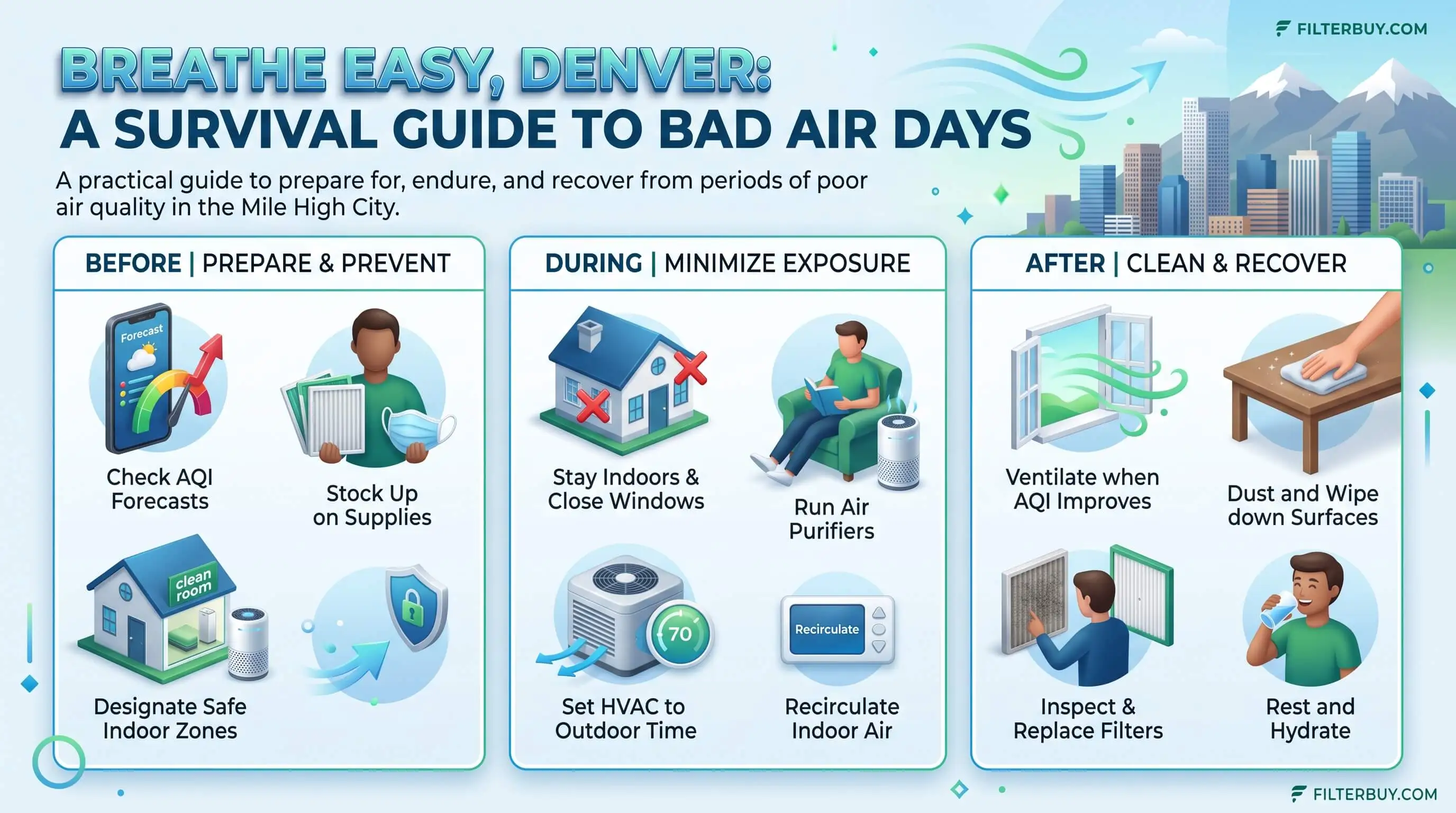
The Colorado Department of Public Health and Environment, or CDPHE, calls an Action Day Alert when air quality is already unhealthy or its forecasters expect it to turn unhealthy later that day or the next. Treat that alert as your signal, along with any Air Quality Index reading above 100.
Each season brings its own culprit, and each one needs a different response.
• Ozone, late May to mid-September. Sunlight turns vehicle and industrial emissions into this gas, and levels peak in the afternoon and evening.
• Wildfire smoke, summer into fall. Fine particles called PM2.5 can ride the wind for hundreds of miles, so a fire two states away can haze out your neighborhood.
• Winter inversions, November through March. A lid of warmer air traps exhaust and wood smoke near the ground. Metro Denver's Action Day burning restrictions run from November 1 through March 31.
Before a Bad Air Day: Prepare Your Home and Your Plan
Clear, boring days make the best prep days, because filters are still on the shelf and nobody at home is coughing yet.
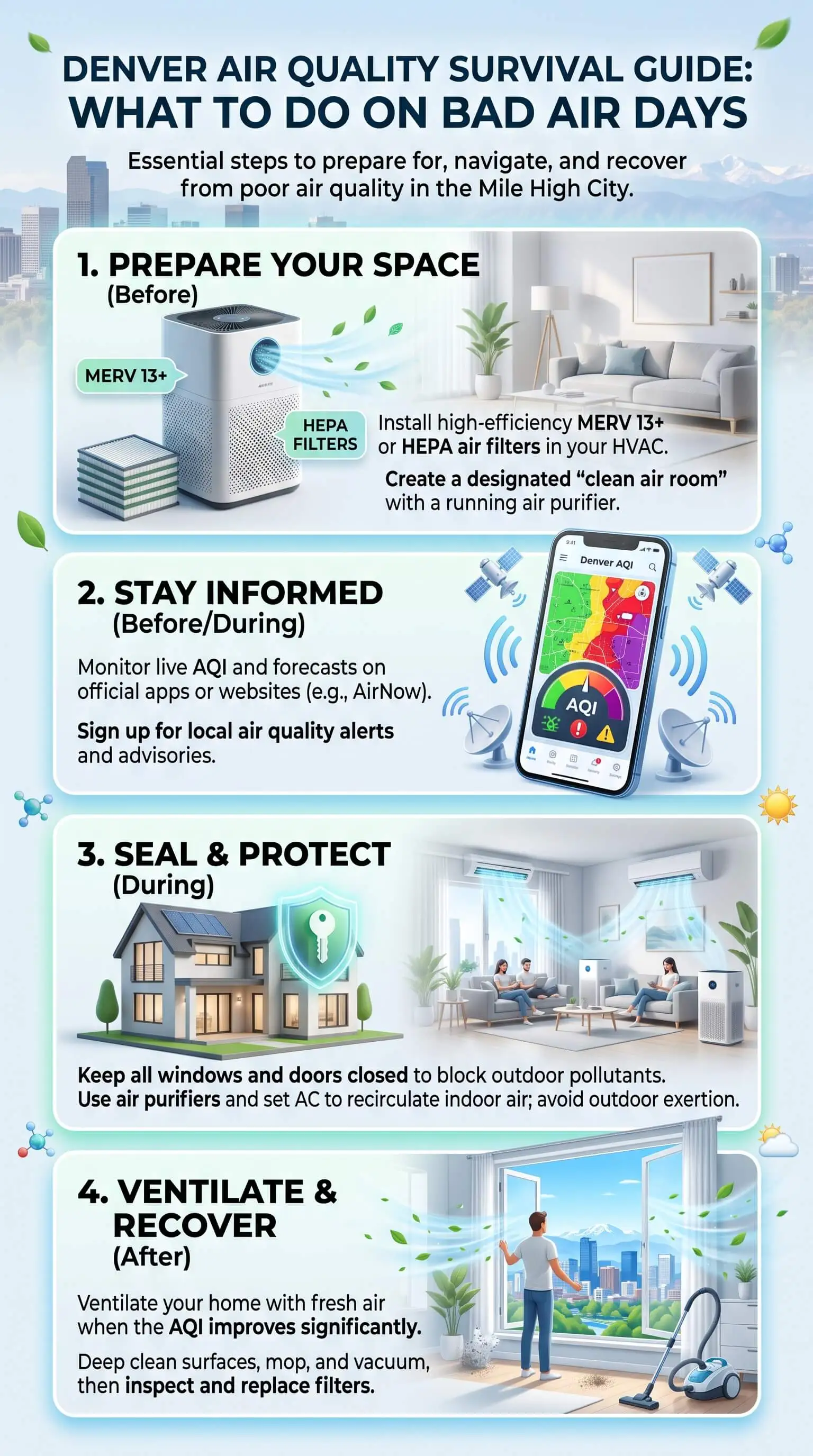
1. Pair the AQI with your weather check. I pull up the live Denver air quality map every morning right after the forecast. Sign up for alerts while you're at it. CDPHE emails daily forecasts, and Simple Steps. Better Air. sends a text only when it calls an Ozone Action Day.
2. Pull your HVAC filter. Note the size and MERV rating on the frame and check for gaps at the edges. The EPA recommends MERV 8 filter or higher during smoky periods if your system can handle it, which an HVAC technician can confirm. Buy a spare or two.
3. Find the fresh-air setting. If your system has a fresh-air intake, ERV, or economizer, locate the damper or recirculate switch now instead of hunting for it with smoke in the air.
4. Make a swamp cooler plan. Evaporative coolers blow outdoor air through wet pads straight into the house, which helps in July and hurts on a smoky day. Line up a backup, like a window AC or an afternoon at the library.
5. Pick your cleaner air room. A bedroom with few windows and no fireplace works well. Size a portable air cleaner to that room and pass on any model that generates ozone.
6. Talk with your doctor. Anyone at home with asthma, COPD, or heart disease needs a smoke plan and several days of medication on hand.
Pro Tip: I treat the first week of November as a fire drill for the house. I slide in a fresh filter, park two spares on the shelf, and circle March 31 on the calendar, the last day of the winter burning restrictions.
During a Bad Air Day: Match Your Response to the Pollutant
Ozone and smoke need different game plans. Filters and N95s catch particles, but ozone is a gas that slips past both, so on ozone days timing protects you better than any gear.
On Ozone Action Days
• Work out early. Ozone builds all afternoon, and alerts usually take effect at 4 p.m.
• Drive and mow less. CDPHE asks residents to cut back on driving, lawn mowing, and painting on alert days, since each one releases ozone-forming compounds.
• Hold off on outdoor burning. The state bans it in the ozone nonattainment area for as long as an alert stays in effect.
On Smoke and Winter Inversion Days
• Close up the house. Shut windows and doors, and set the fresh-air intake to recirculate.
• Flip the thermostat fan from Auto to On. Your filter only cleans air that moves through it, and Auto lets the fan sit idle between heating or cooling cycles.
• Shut off the swamp cooler. It skips your furnace filter completely.
• Move into your cleaner air room. Run the air cleaner on high and spend as much of the day there as you can.
• Keep new particles out of the air. Skip candles, frying, broiling, and vacuuming without a HEPA filter, and leave the wood stove cold in winter.
• Wear an N95 outside. A NIOSH Approved N95 filters smoke particles, while dust masks and bandanas let them straight through.
• Know when to call. Trouble breathing, a cough that won't quit, or chest pain means a call to your provider or 9-1-1.
After a Bad Air Day: Reset Your Indoor Air
Smoke lingers for days, so wait for the AQI to drop before you reset the house.
1. Air it out. Open windows or the fresh-air intake once readings improve, even for an hour.
2. Check the filter. Swap it if it's turned dark gray or brown, since a heavy smoke week loads a filter far faster than the schedule on the package assumes.
3. Wipe down the dust. Use a damp cloth on hard surfaces and a HEPA vacuum on carpet.
4. Look over the swamp cooler pads. Replace any that look stained or smell like a campfire before the cooler runs again.
5. Put your settings back. Return the fan to Auto and jot down what worked. A routine HVAC checkup before furnace season confirms your filter fits.
"On smoky-day service calls along the Front Range, the first thing I check is whether the swamp cooler or the fresh-air intake is still running. Both pull outdoor air in without sending it through the furnace filter. I've seen homeowners install a MERV 13 filter while their cooler kept pushing smoke into the living room."
7 Essential Resources
1. Live Denver Air Quality Index Map. Check current Denver AQI readings alongside plain-language filtration tips for every level.
2. CDPHE Air Quality Monitoring and Advisories. Learn how Action Day Alerts and winter burning restrictions work, and find the Front Range forecast hotlines.
3. Simple Steps. Better Air. Alert Sign-Up. Get a text or email only on days the program calls an Ozone Action Day.
4. AirNow: Be Smoke Ready. Use a preseason checklist for spare filters, air cleaners, and a cleaner air room.
5. CDC: Wildfire Smoke and People with Chronic Conditions. Find specific steps for households managing asthma, COPD, heart disease, or diabetes.
6. Denver Love My Air. See the city's own sensor readings, closer to your block.
7. National Weather Service Fire Weather. Watch fire weather outlooks that hint at smoke before it reaches the Front Range.
Together, these resources help Denver households track local air conditions, prepare for ozone and wildfire smoke, and know when top air filters can play a bigger role in protecting indoor air.
3 Statistics
66 days over the line. The Front Range saw 66 days in 2026 with ozone above the federal standard, among the worst seasons since 2000. Source: Regional Air Quality Council
8th worst in the country. The American Lung Association's 2026 "State of the Air" report ranked Denver-Aurora-Greeley 8th worst for ozone. Jefferson County averaged 29.7 unhealthy days a year. Source: American Lung Association
Closed windows only get you partway. EPA reports indoor PM2.5 during smoke events typically runs 55 to 60 percent of outdoor levels with doors and windows shut and no air cleaner. A high-efficiency filter with the fan running continuously can cut PM2.5 by about half. Source: U.S. Environmental Protection Agency
Final Thoughts and Opinion
I'd argue the most useful Denver air quality habit happens weeks before any alert, on a clear morning with coffee in hand, when you check the filter and pick your cleaner air room.
The two settings I see overlooked most in Denver homes are the swamp cooler switch and the thermostat fan. A running cooler can pull smoke indoors all afternoon unnoticed. A fan left on Auto lets your filter sit idle. Regular HVAC maintenance helps keep those systems working the way they should. You're the hero of your household here, and those two switches give you a lot of control for very little effort.
Frequently Asked Questions
Why is Denver air quality worse on summer afternoons?
Ground-level ozone forms when sunlight reacts with vehicle and industrial emissions, so it builds through hot afternoons and peaks late in the day. That's why Ozone Action Day Alerts usually start at 4 p.m., and why mornings make a better window for a run or a bike ride.
Does closing windows keep wildfire smoke out of my house?
Closing windows helps, but smoke still leaks in, often keeping indoor PM2.5 above half of outdoor levels. A snug high-efficiency filter, a fan set to On, and a portable air cleaner close most of the gap.
What is the brown cloud in Denver?
Denverites call the winter haze that forms during temperature inversions the brown cloud. A layer of warmer air traps colder air near the ground, and vehicle exhaust and wood smoke collect under that lid until wind or a storm mixes it out.
How often should I change my air filter after a smoky week?
Check it as soon as the smoke clears and replace it if it looks dark gray or brown. Heavy smoke loads filters fast, so a 90-day filter may need replacing within a few weeks during an active fire season.
Take Control of Your Air on Denver's Worst Days
What you do before, during and after a bad air day decides how much of Denver's haze reaches your family. Check your filter and choose your cleaner air room while the air is clear, then let your alerts tell you when to use them so everyone at home breathes easier.